Festival of Stories: Reflecting on The Habit of Reading


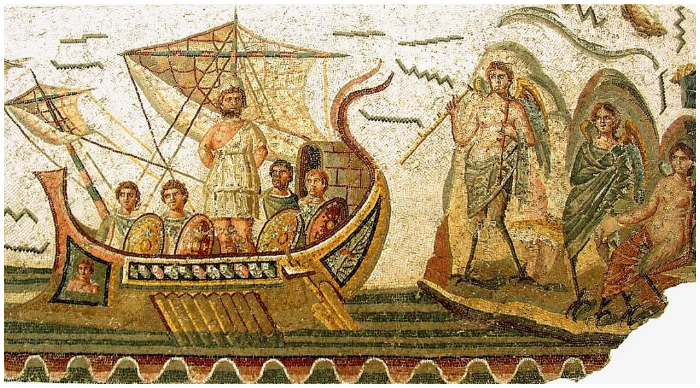
Imagine the human soul as an ocean. A vast ocean, with all of its currents and undercurrents and waves of thoughts, feelings, ideas, ideals, dreams, hopes and fears. Now imagine we are navigating this broad ocean, with all of its storm-tossed currents, in a large, heavy ship. This ship is navigated through the currents - responsibilities, deadlines, homework, projects, family and friends - all of which may potentially cause storms. To successfully navigate the ocean we require assistants, fellow sailors and deckhands; direct advisors to help us make sense of the map. For every person, every learner, there comes a point where these wise assistants help us direct the sail. Wise assistants that allow us to tap into knowledge and experience. Those wise assistants, are books.
As Senior School celebrates the Dulwich College Shanghai Puxi Festival of Stories we are taking the time to ponder, reflect, and consider the fundamental nature of reading. We are exploring how reading books give us inspiration through the journey of life, helping us to use language efficiently.
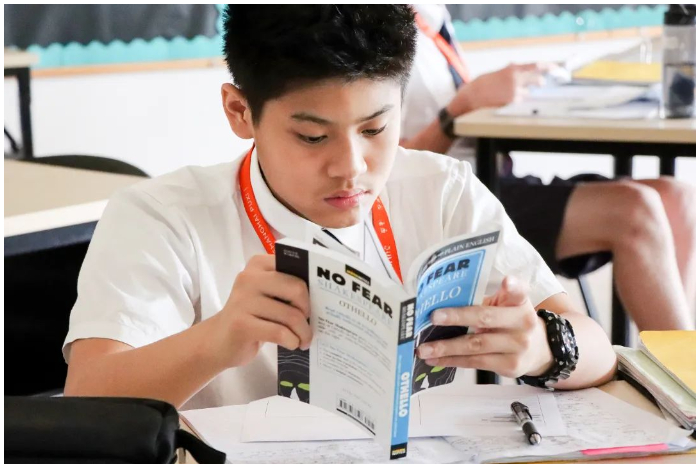
Attention Spans and the Importance of Concentration
————
We all are very much aware of the impact of technology has had on concentration spans. COVID-19 has amplified this impact and increased our hunger for instant information. The digital age has created a “three-minute culture” where we are wired to switch to the next topic quickly and where we are unable to focus for an extended period of time. This is causing language development to be impacted. Schools in Iceland fear that excessive internet usage is causing the language to eventually disintegrate and “die out” (Murphy, 2018). At Dulwich College Shanghai Puxi we are tackling this by investing heavily in our reading programmes and helping our students become immersed in the world of books. We know that students who are able to read for extended periods of time, rather than flicking through content on their mobile phones, are actively working to improve their concentration spans.
Various scientific studies indicate that small doses of habitual book reading for thirty minutes every night ensures that concentration and memory is improved.

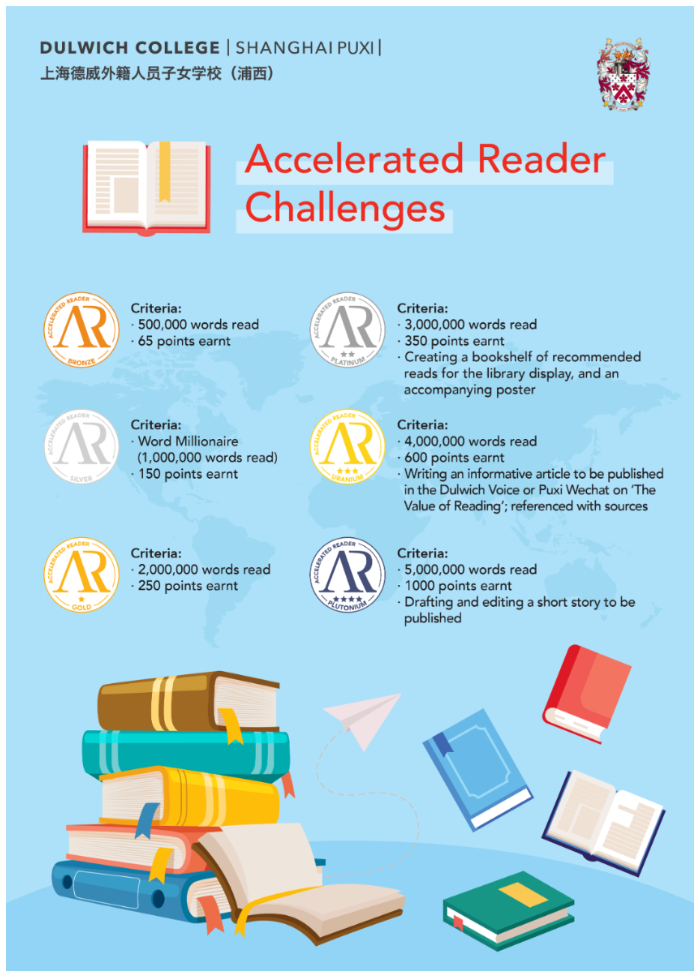
One tool we have used to address this is Accelerated Reader, which has given students additional opportunies to engage with reading regularly and created a motivation for them to read for pleasure, rather than seeing it as a chore. The Senior School English team have been working hard to develop student’s reading interests by building literacy and oracy skills through activities such as active verbal reading in library times, Accelerated Reader based quizzes, and collaborative reading circles. These act to boost the confidence of students who may otherwise be less engaged in reading.
Our students are in charge of actively building their own vocabulary. They are incentivised to do so, as they can gain points and achieve a series of awards (From Bronze, Silver and Gold all the way up to Platinum, Uranium and Plutonium). Students can achieve awards by engaging in literacy related tasks, such as creating bookshelves for our library door display, writing informative articles and drafting and editing short stories that are published. All of these actions inspire our community of students to keep reading, and keep focused for extended periods of time rather than being distracted by the online world. As a result of the things we do, we have created a culture of reading at the College. Our students love to read! They read at any given opportunity, and the stories they enjoy become topics of conversation amongst friends.
The Importance of Literacy
————
Literacy is at the core of everything that we do. We, as educators, have a responsibility to inspire a love and passion for reading and ensure that this passion is ingrained in the lives of our community members. This passion is something to be nurtured. It is a life-long passion that gives our children the opportunity to be fluent, dignified communicators who show articulacy in the spoken and written form. Setting reading times, building an archive reading log of books and making book reviews all help to actively build memory strength, improve verbal recall, prevent stress and anxiety and generate a positive wellbeing. All of these are important, and are related to reading.

The Process of Deciphering Written Language
————
The exciting process of beginning to read only becomes effective if it is habitual. As we start to read, we initiate the process by seeing the patterns and shapes on the page; and subsequently these pictures are delivered to the back of the brain where they are processed. These are then sent to the temporal lobe, specifically to an area called the brain’s ‘letter box’.

This is where the brain is able to identify a letter or a word. The information is then sent to the frontal lobe and other areas of the temporal lobe and, consequently, we learn pronunciation and meaning. When people read regularly, they are exercising these muscles, making them stronger and improving their abilities.

How We Instill a Love of Reading in Senior School
————
In addition to the actions explained above, in Senior School we engage in a range of activities to help our students build a love of reading. A few quick examples of these are;
-
Vocabulary development
Weekly vocabulary tests encourage our students to take ownership of their understanding of words. We specifically teach a curiosity in academic vocabulary by exploring the etymology of a complex word; breaking it down by prefix or affix. This is because research indicates that there is a clear dichotomy within students at KS3, 4 and 5 and a vocabulary gap between our ‘word poor’ and ‘word rich.’

-
Reading interests
We encourage reading for pleasure, and if you walk through our halls you will see that almost every students carries a book with them throughout the day, for those moments when that have some time to read. Reading regularly for pleasure offers tremendous rewards and as our students arrive at Year 7 we aim to ensure that they encounter at least one million words a year. This is proven to dramatically improve their results in other areas (Quigley, 2018).

-
Retrieval practice
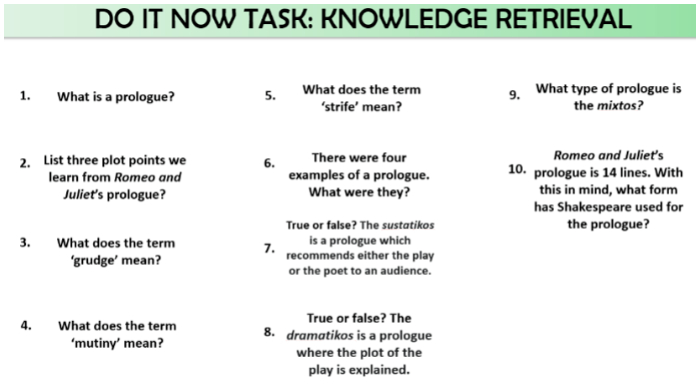
In addition to reading for pleasure, our students have ample opportunity to read both non-fiction and academic texts. In our teaching of Literature, one of the key elements we encourage is prior academic reading. We use knowledge retrieval statements and established routines to encourage the retrieval of prior knowledge through academic reading. This doesn’t necessarily have to be at the start of the lesson but can be at various stages throughout (Jones, 2021). Examples of these include the following below; as shown in Miss Rees’s First Language IGCSE Literature preparation of Year 9’s study of Romeo and Juliet:
-
Reading through oracy
Reading out loud promotes confidence and allows students to improve pronunciation, oracy and tone. Practice makes perfect, so it is important that whether it is in lessons, in the library or at home, we build opportunities for our students to read aloud. Our Senior School English teachers create regular reading through oracy opportunities, because we see strong benefits when our students have the opportunity to listen to their peers and teachers read aloud also.

References
Blatchford, Roy, The Restless School, Ashford Colour Press, 2014.
Jones, Kate, Retrieval Practice: Resource Guide, John Catt, 2021.
Murphy, James and Dianne, Thinking Reading ‘What Every Secondary Teacher Needs to Know About Reading', John Catt Publication, 2018.
Quigley, Alex, Closing the Vocabulary Gap, Routledge, 2018.